Issue 7
$13.00
Description
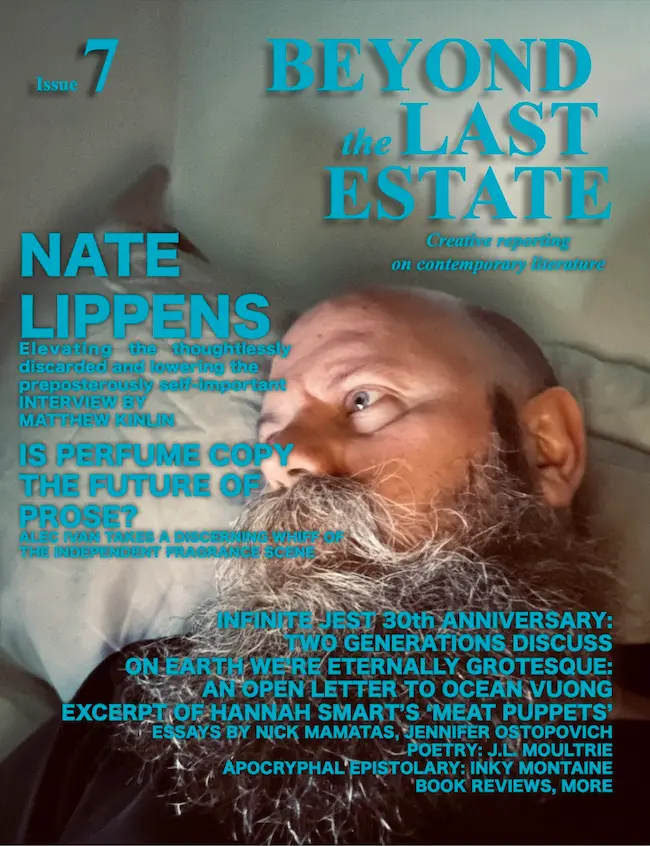
Cover story on Nate Lippens, author of Bastards (2026, Semiotext[e])
Interview by Matthew Kinlin
MK: It just sounds like something written on LinkedIn. You talk about the term queer in the book. Can I just read? “The term has been drained of anything radical and become a Tupperware term for kink-shaming hall monitors.”
NL: I just saw a headline about “queering sleep hygiene,” so RIP to the word queer as anything but a lifestyle to be packaged and sold. Queer has basically become meaningless. For me, the word will always be rooted in Queer Nation and the confrontational street activism of the early 90s. Something we could really use now, rather than a series of self-satisfied, fear-mongering Instagram reels, but then people would have to leave their homes and interact. You can’t send UberActivist through an app to do your work.
MK: I think what you’re saying there is if the language loses its specificity, then it loses some of its political weight. It gets co-opted and loses any social worth. There’s quite a funny quote about drag shows. From earlier forms of drag to now, you alluded to them as “a defanged clown show”.
NL: It’s the double-edged sword of RuPaul’s Drag Race bringing drag to global attention. It redefines how a lot of people do drag and what they expect to see on stage. To that audience, if you’re not up there in an expensive, astonishing outfit or doing elaborate dance moves, then you’re not a drag queen… I want to be slightly humiliated at a show. And I want to be a little afraid in the front row.
DECADENCE OF OUD:
The Contemporary Literature of an Independent Fragrance House and How it Moved Me Toward Creative Inspiration in the Haze of Capitalism
by Alec Ivan
She breathes in deep. Something stirs within her, and it’s palpable, and makes me feel nauseous. She says to us, through minute shivers, a mouthpiece now:
“Hate all governments and love all people.”
It’s in this final line that with a single shuddering breath, she surprises herself, surprises us, and begins to cry.
She tells us that she understands now, the way Inexcusable Evil smells, why it forms its body in such a way, why it is so repulsive to so many people. She realizes that it isn’t just the scent that matters. It’s what it stands for. And I thought we wouldn’t know what it stood for without that little piece of apocalyptic writing, that flare for a certain type of literature that tends to hide in the deeper corners of the Internet or inside the pages of circulating zines passed out at bars late at night. Without that product page, what would we have? Without the imagery of the write-up, we’d have next to nothing except for a vaguely shitty perfume that people generally hate. The writing made it something more than that. The writing brought it to life.
CULT OF NONE: When All Your Wildest Dreams Come True
by Nick Mamatas
I thought I’d be a cult writer. What I didn’t get is that most cults are pretty big. Jean Genet was huge in the 1960s. Kathy Acker was a regular on television in the United Kingdom. Philip K. Dick died poorish because he was a speed-freak, not because he was obscure. His attractive daughter and tireless advocate Isa Dick drove down to Hollywood with copies of his paperbacks in the 1980s, became a high-level producer, and never returned to the Bay Area. Bob Black was as “marginal” as the zine-writers he championed, but he’s an attorney for God’s sake, and most of the marginals were basically outsider artists, i.e., mental defectives. Was Gerry Reith a libertarian provocateur or just a suicidal paranoid schizophrenic who thought his boss at the hotel where he worked was using Masonic mind-control techniques on him? Did you know that one of John Zerzan’s main complaint about today’s world is that teenagers cannot read paper maps?
ON EARTH WE’RE ETERNALLY GROTESQUE: A Letter to Ocean Vuong
By Alexander Benedict
…However, in abandoning any vital relation to history or the future, the poetic novel of our time fails to confront our past and fails also to be timeless. In short, it fails to either be a novel or poetry. A fiction not parasitic to the world, but parasite only to its authors. Can we still take up Morrison’s project, if only as one would a shattered mirror, carefully gathering the pieces into the imagined wounds of a history yet to be received and a future still being imagined? Can poetry and history still act as that bridge to a free society? Perhaps not. Literature will have nothing to contribute in overcoming our exploitation or the domination of our society by money, but we can at least do more than actively or passively write out in acceptance of the shit and hell of modern life. I will take nothing less than the entirety of the future as my inheritance. No, Ocean, the ash of your inherited table does not harden into ink on this very page. But even this lies on a false premise. In your “letters” you’ve made taxidermy of not only your family but also yourself. The conceit of your address is how it cannot be read by your mother, but it is just this, a conceit. In no way do you attempt to reach your mother, which is why you repeat this in each of your poems and novels. Of course, my letter relies on the same premise as your books, but whether this letter reaches you is incidental.
THE OBSOLESCENCE OF LEGACY
By Jennifer Ostopovich
In contrast, within independent magazines it’s not uncommon to see work from truly marginalized writers such as sex workers, people with severe mental illness, addicts, or, as in J.L.’s case, people who’ve struggled with homelessness. It’s common to see writers who’ve never had the resources to make it into an MFA program, and who, even if they could make it past the multiple social and economic barriers, would never be admitted because their work is too transgressive or doesn’t conform to cautious academic sensibilities. Conversely, this work is given careful consideration by the (typically unpaid) editors who often fund their indie magazines out of their own pockets, and the work is frequently published alongside academics and popular writers with extensive writing backgrounds to equal reception. Inclusion is the standard in independent literature, where it’s not uncommon to see radical Marxists, right leaning libertarians, dropouts, and PHDs all published within the same journal.
INJESTED:
A Gen Xer and a Millennial Contemplate Their First Time Reading One of the Most Confounding, Divisive, and Enlightening 1000+ Page Novels of Our Time in the Year of Its 30th Anniversary
by Gabriel Hart & Eric Subpar
Gabriel: She saw me reading it and she kinda gasped, like she was spooked. She asked “Do you think there’s anything in that book that could lead someone to, you know…” And I obviously shrugged it off, but then the more I read it, the more I felt like this work, more than any book I’ve read, is perhaps the clearest transference of an author’s depression onto the reader. Did you get that? Like down to the cellular detail of someone who overthinks everything. And even though I tend to get sidetracked by my own depression, I gotta say, for whatever reason, my mental health went into a very specific, unexpected dark place while reading it. Again, I could have been projecting, but it also felt undeniable. And maybe it’s due to the way it’s structured that tends to mimic depression? You know, with the footnotes you have this ‘two steps forward, three steps’ back whiplash that feels Sisyphean. Landmines. Like “Fuck!” Back to other bookmark where the footnote is ten pages long.
Eric: It definitely put me into a couple depressions. I remember reading a couple passages and the next day feeling kind of dark, in the same way that a fucked-up dream can alter your day.
PLUS: Poetry by J.L. Moultrie, excerpt from Meat Puppets by Hannah Smart, Inky Montaine returns to Mailbox Baseball with eye-bulging apocrypha, book reviews, and more.